
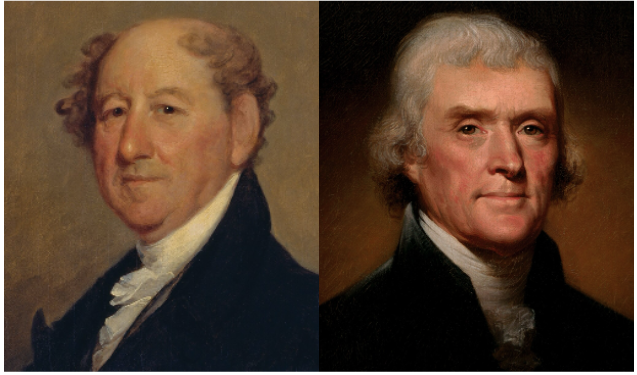
Rufus King on the Missouri Bill – November 22nd, 1819
… If three-fifths of the slaves are virtually represented, or their owners obtain a disproportionate power in legislation, and in the appointment of the President of the United States, why should not other property be virtually represented, and its owners obtain a like power in legislation, and in the choice of the President? Property is not confined in slaves, but exists in houses, stores, ships, capital in trade, and manufactures. To secure to the owners of property in slaves greater political power than is allowed to the owners of other and equivalent property, seems to be contrary to our theory of the equality of personal rights, inasmuch as the citizens of some States thereby become entitled to other and greater political power than the citizens of other States. The present House of Representatives consist of one hundred and eighty-one members, which are apportioned among the States in a ratio of one representative for every thirty-five thousand federal members, which are ascertained by adding to the whole number of free persons, three-fifths of the slaves. According to the last census, the whole number of slaves within the United was 1,191,364, which entitles the States possessing the same to twenty representatives, and twenty presidential electors more than they would be entitled to, were the slaves excluded. By the last census, Virginia contained 582,104 free persons, and 392,518 slaves. In any of the States where slavery is excluded, 582,104 free persons would be entitled to elect only sixteen representatives, while in Virginia, 582,104 free persons, by the addition of three-fifths of her slaves, become entitled to elect, and do in fact elect, twenty-three representatives, being seven additional ones on account of her slaves. Thus, while 35,000 free persons are requisite to elect one representative in a State where slavery is prohibited, 25,559 free persons in Virginia may and do elect a representative: so that five free persons in Virginia have as much power in the choice of Representatives to Congress, and in the appointment of presidential electors, as seven free persons in any of the States in which slavery does not exist.
This inequality in the apportionment of representatives was not misunderstood at the adoption of the Constitution, but no one anticipated the fact that the whole of the revenue of the United States would be derived from indirect taxes (which cannot be supposed to spread themselves over the several States according to the rule for the apportionment of direct taxes), but it was believed that a part of the contribution to the common treasury would be apportioned among the States by the rule for the apportionment of representatives. The States in which slavery is prohibited, ultimately, though with reluctance, acquiesced in the disproportionate number of representatives and electors that was secured to the slaveholding States. The concession was, at the time, believed to be a great one, and has proved to have been the greatest which was made to secure the adoption of the Constitution.
Great, however, as this concession was, it was definite, and its full extent was comprehended. It was a settlement between the original thirteen States. The considerations arising out of their actual condition, their past connection, and the obligation which all felt to promote a reformation in the Federal Government, were peculiar to the time and to the parties, and are not applicable to the new States, which Congress may now be willing to admit into the Union.
The equality of rights, which includes an equality of burdens, is a vital principle in our theory of government, and its jealous preservation is the best security of public and individual freedom; the departure from this principle in the disproportionate power and influence, allowed to the slaveholding States, was a necessary sacrifice to the establishment of the Constitution. The effect of this concession has been obvious in the preponderance which it has given to the slaveholding States over the other States. Nevertheless, it is an ancient settlement, and faith and honor stand pledged not to disturb it. But the extension of this disproportionate power to the new States would be unjust and odious. The States whose power would be abridged, and whose burdens would be increased by the measure, cannot be expected to consent to it, and we may hope that the other States are too magnanimous to insist on it.
Thomas Jefferson to James Monroe – March 3rd, 1820
… I am indebted to you for your two letters of Feb 7 & 19 this Missouri question by a geographical line of division is the most portentous one I have ever contemplated. King is ready to risk the union for any chance of restoring his party to power and wriggling himself to the head of it. nor is Clinton without his hopes nor scrupulous as to the means of fulfilling them. I hope I shall be spared the pain of witnessing it either by the good sense of the people, or by the more certain reliance, the hand of death.
Thomas Jefferson to Charles Pinckney – September 30th, 1820
… I have not read a speech in Congress for some years. I have heard indeed of the questions of the Tariff & Missouri, and formed primâ facie opinions on them, but without investigation… the Missouri question is a meer party trick. the leaders of federalism defeated in their schemes of obtaining power by rallying partisans to the principle of monarchism, a principle of personal, not of local division, have changed their tack, and thrown out another barrel to the whale. they are taking advantage of the virtuous feelings of the people to effect a division of parties by a geographical line. they expect that this will ensure them, on local principles, the majority they could never obtain on principles of federalism. but they are still putting their shoulder to the wrong wheel. they are wasting Jeremiads on the miseries of slavery as if we were advocates for it. sincerity in their declamations should direct their efforts to the true point of difficulty, and unite their councils with ours in devising some reasonable and practicable plan of getting rid of it. some of these leaders, if they could attain the power they ambition, would rather use it to keep the union together. but others have ever had in view it’s separation. if they push it to that, they will find the line of separation very different from their 36° of latitude.
Thomas Jefferson to Albert Gallatin – December 26th, 1820
… but nothing has ever presented so threatening an aspect as what is called the Missouri question. the Federalists completely put down, and despairing of ever rising again under the old division of whig and tory, devised a new one, of slave-holding, & non-slave-holding states, which, while it had a semblance of being Moral, was at the same time Geographical, and calculated to give them ascendancy by debauching their old opponents to a coalition with them. Moral the question certainly is not, because the removal of slaves from one state to another, no more than their removal from one county to another, would never make a slave of one human being who would not be so without it. indeed if there were any morality in the question, it is on the other side; because by spreading them over a larger surface, their happiness would be increased, & the burthen of their future liberation lightened by bringing a greater number of shoulders under it. however it served to throw dust into the eyes of the people and to fanaticize them, while to the knowing ones it gave a geographical and preponderant line of the Potomac and Ohio, throwing 14 states to the North and East, & 10 to the South & West. with these therefore it is merely a question of power: but with this geographical minority it is a question of existence.
Thomas Jefferson to Marquis De Lafayette – December 26th, 1820
… With us things are going on well. the boisterous sea of liberty indeed is never without a wave, and that from Missouri is now rolling towards us: but we shall ride over it as we have over all others. it is not a moral question, but one merely of power. it’s object is to raise a geographical principle for the choice of a president, and the noise will be kept up till that is effected. all know that permitting the slaves of the South to spread into the West will not add one being to that unfortunate condition, that it will increase the happiness of those existing, and by spreading them over a larger surface, will dilute the evil every where and facilitate the means of getting finally rid of it, an event more anxiously wished by those on whom it presses than by the noisy pretenders to exclusive humanity. in the mean time it is a ladder for rivals climbing to power.
https://www.gutenberg.org/files/15392/15392-h/15392-h.htm#link2H_4_0005
 Black Horse Camp #780