
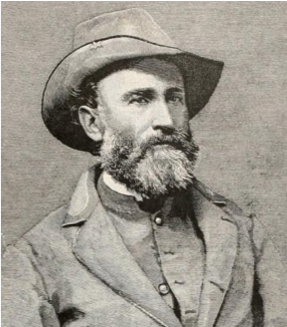
The Heritage of the South by LtGen Jubal Early, CSA – 1915
By the commencement of the canvass for the Presidency in 1860, the Democratic party had become divided on the question of the construction of the slavery clause in the Kansas-Nebraska bill: that is whether the power to exclude or adopt slavery could be exercised by the people of the territories while in the territorial condition. Mr. Douglas and the greater portion of the Northern Democrats contended for the former view, while nearly all of the Southern Democrats advocated the latter. It was contended by the Southern Democrats with great force and justice that if Congress did not have the power to exclude slavery, the legislatures of the territories, which derived their powers from the acts organizing the territories could not have that power. This view was conclusive, for the territorial legislatures, being now temporary bodies deriving their sole powers from the acts of Congress, could not exercise greater powers than the body which created them, while the people, when they came to form constitutions, under that clause of the Constitution of the United States providing for the admission of new states on the same footing with the old, were necessarily vested with that sovereign power over this subject and all others which belonged to the original states.
The Northern Democrats contended for what was called “Squatter Sovereignty,” that is, that this sovereign power of legislation vested in the settlers of the territories from the beginning, and to propitiate the free-soil sentiment, many of them contended that the clause in the Kansas-Nebraska bill secured the territories to the north and free-soil more effectually than could be done by Congressional legislation, as settlers from the North could more readily take possession of the territories and exclude slavery from them, than settlers from the South could introduce slavery there, while in Congress the Southern Representatives especially in the Senate where the sections were more nearly equal, could, with the aid of a few Northern men, prevent any interference with slavery. This view of the subject made the doctrine of squatter sovereignty even more offensive than what was called the Wilmot proviso, and Southern men contended that it was a trap to entrap them.
It was in fact not a question of construction of the clause in the Kansas-Nebraska bill but of the Constitution itself. If Congress had no power to legislate on the subject, then it could delegate none, and if there was such a thing as “squatter sovereignty” it extended to all other subjects as well as to slavery, and the settlers in the territories might set up for themselves without any authority from Congress, which would involve some very extraordinary consequences, including that even of disposing of the public lands. The squatter sovereignty view of the question was one not to be tolerated; and it applied to the Utah and New Mexico bills as well as to that in regard to Kansas and Nebraska.
The great mass of Southern Whigs agreed with the Southern Democrats in their way of interpreting the principle, but they did not regard the question as one of sufficient practical importance to make a fight over, and old party divisions and feuds prevented a coalescence of all of the Southern men.
Though considered by many an abstract question, as it certainly was so far as it applied to Kansas and Nebraska, it seemed to divide the Democratic party into two wings, a Northern and a Southern one, with some adherents to either wing from the opposite section. This division resulted in the nomination of two sets of candidates by the Democratic party—Douglas of Illinois and Johnson of Georgia by the Northern wing, and Breckenridge of Kentucky and Lane of Oregon by the Southern wing. The Republican free-soil or abolition party nominated Lincoln of Illinois and Hamlin of Maine, while the Southern Whigs and a remnant of Northern Whigs, who had not fused with the free-soilers and abolitionists, nominated Bell of Tennessee and Everett of Massachusetts. The advocates of this latter ticket proposed to sink every other issue and stand for “The Union, the Constitution, and the enforcement of the Laws.”
At the election in 1860, Lincoln and Hamlin received the majority of the popular vote in nearly all of the Northern states and by that vote alone secured a majority of the votes of the electoral colleges, but they lacked very nearly 1,000,000 votes of receiving a majority of the combined popular vote of the United States. In this election the Southern people were unanimous in their opposition to Lincoln and Hamlin though divided as to the other candidates, the few thousands of votes given on the border for the Republican ticket, being given by Northern men who had emigrated across the line, and amounting to a very inconsiderable fraction.
It was the first time in the history of the Government that a mere sectional candidate had been elected and this was done upon sectional issues alone. This result presented an alarming state of things and developed the fact that under a Republican form of Federal Government, with suffrage nearly universal, it was perfectly practicable for a minority to get possession of the government on sectional issues and perhaps control it permanently. There had been, before, presidents elected by a minority popular vote, but this was on National issues and the support of the successful candidate was confined to no particular section. Of the thirteen presidents elected, seven had been elected from Southern states, and all of them received majorities of the popular vote except Mr. Polk of Tennessee, and his principal opponent was Mr. Clay of Kentucky, a Southern man.
Six had been selected from Northern states, and but one of them, Harrison of Ohio, but a native of Virginia, received a majority of the popular votes.
Of the Southern presidents, Washington’s electoral vote was unanimous. Jefferson received twenty Northern electoral votes at his first election, and all but nine of them at his second. Madison received a majority of Northern electoral votes at his first election and forty of them at his second. Monroe received a very large majority of Northern electoral votes at his first election and all but one at his last, that being the only vote cast against him. Jackson received 73 Northern and Northwestern electoral votes out of 147 cast, at his first election and a very large majority at his second election. Polk received 103 of the same vote to 58 cast for Mr. Clay and Taylor received a large majority of the same vote.
Of the Northern presidents, John Adams received 12 electoral votes from the South. John Quincy Adams received six electoral votes from the slave states and was elected by the House of Representatives, receiving the votes of several slave states. Van Buren received 61 out of 126 votes cast by the slave states, 28 of the rest being cast for Harrison. Harrison received a large majority of Southern electoral votes, as did Pierce and Buchanan and in every election the majority of Northern electoral votes had been cast for the successful candidates, except at Jefferson’s first election, Madison’s second, Jackson’s first and Buchanan’s election and in this the majority of that vote had been cast for Fremont, the sectional Republican candidate. Two vice-presidents, Tyler from Virginia and Fillmore of New York, had succeeded to the presidency by the deaths of the incumbents and both of them had received majorities of the popular vote as well as of the Northern electoral vote.
Lincoln’s election therefore was the first instance of the election of a mere sectional president. It was very evident that if the party electing him continued in possession of the government for any length of time, there would inevitably follow a subversion of the rights of the states and a consolidation of all power in the Federal government under the control of a sectional majority, not a majority of the whole. This form of consolidation promised to be infinitely worse than an entire obliteration of all state lines and a concentration of power in the hands of the entire people.
Under the circumstances attending the election of Lincoln, those of the Southern states which are usually designated the “Cotton States” deemed that their own safety required their withdrawal from the Union, and they consequently withdrew. The legislature of South Carolina was in session for the purpose of appointing electors for president, and when the result was ascertained, a convention for that state was called, which adopted an ordinance of secession on the 20th of December, 1860. Georgia, Florida, Alabama, Mississippi and Louisiana soon followed the example of South Carolina, and a Congress of the seceding states met at Montgomery, Alabama, early in February, 1861, and organized a provisional government under the style of the “Confederate States of America,” of which the Honorable Jefferson Davis, of Mississippi, was appointed President, and the Honorable A. H. Stephens, of Georgia, Vice-President.
Texas had previously adopted an ordinance of secession which went into effect when it was certified by the popular vote and that state soon afterwards became also one of the Confederate States.
A permanent constitution was adopted for the Confederate States to go into effect on the 22d of February, 1862, modelled after that of the United States, but containing some changes in the details and the powers delegated, with more ample recognition of states rights and a prohibition of the introduction of slaves from any other than the slave-holding states and territories of the United States.
The secession of these states had been without violence, except to take possession of some forts and arsenals of the United States within the limits of the seceding states, which had been accomplished without bloodshed. Commissioners were appointed to the United States government, to effect a peaceful settlement of all questions between the two governments in regard to the public debt, territory, etc.
This change in the relations of the seceding states to the United States resulted in no change whatever in the domestic affairs of those states, but they continued to be regulated as before under the laws and constitutions of the several states.
https://www.gutenberg.org/cache/epub/63254/pg63254-images.html#CHAPTER_IV
 Black Horse Camp #780